-
- The myth and truth of Godhra
By Arvind Lavakare - Since no ?secularist? or ?liberal? or ?objective? person ever challenged the above sets of figures, some questions arise: Who killed 200-odd Hindus so early in those riots? Was it the police or the Hindus themselves? And what made those 40,000 Hindus rush to relief camps? Was it fear of Hindu mob violence, rape, arson and murder?
- Since no ?secularist? or ?liberal? or ?objective? person ever challenged the above sets of figures, some questions arise: Who killed 200-odd Hindus so early in those riots? Was it the police or the Hindus themselves? And what made those 40,000 Hindus rush to relief camps? Was it fear of Hindu mob violence, rape, arson and murder?
- Since no ?secularist? or ?liberal? or ?objective? person ever challenged the above sets of figures, some questions arise: Who killed 200-odd Hindus so early in those riots? Was it the police or the Hindus themselves? And what made those 40,000 Hindus rush to relief camps? Was it fear of Hindu mob violence, rape, arson and murder?
- even as some Hindus in Vadodra, Ahmedabad and a few other parts of Gujarat were provoked into insane killing, arson and loot by the S-6 carnage, the Muslims in that state were hardly the cattle hiding from the slaughter house that they have been made out by the ?secularists? in and outside our national English media. Do you, for instance, recall reading about the mutilation of Mukesh Panchal?s cadaver in any of the English print media? Did you hear a sound byte about it on our TV?
- This trend was discernible to the objective person four years ago itself. Thus, in its issue of April 28, 2002, The Times of India reporter, Sanjay Pandey, told us that of the 726 people who had been killed by then in the post-Godhra riots, 168 were Hindus. In its issue of June 24, 2002, India Today carried an article saying that the official figure of all people killed in Gujarat in the three months following the S-6 massacre was 800, of which a quarter were Hindus. The Union Home Ministry?s Annual Report 2002-03 said that about a third of the total dead in the Godhra riots were Hindus. It also said that, at one stage, 40,000 Hindus were in riot relief camps.
- Since no ?secularist? or ?liberal? or ?objective? person ever challenged the above sets of figures, some questions arise: Who killed 200-odd Hindus so early in those riots? Was it the police or the Hindus themselves? And what made those 40,000 Hindus rush to relief camps? Was it fear of Hindu mob violence, rape, arson and murder?
- Based on the considerable oral, audio and visual evidence obtained from the above interactions, the Justice Tewatia team?s conclusions most relevant to the blindfold on Godhra were as follows:
-
-
a very high traffic of telephone calls was recorded between Godhra and Pakistan, especially Karachi, before the date of the carnage
-
an abnormally large number of passports were issued,
-
there was a large number of persons without ration cards
-
a large number of unemployed Muslims had mobile phones,
-
though there is no tradition of being a Muslim pilgrim center and the local Muslims are not affluent, three istema (religious gatherings) have been held and attended by large numbers of foreigners, and
The actual perpetrators were jehadi elements in the predominantly Muslim town of Godhra where
-
- Will the criminal conviction of 16 by two separate sessions judges in Ahmedabad remove the blindfold on Godhra that the ?monster media? put on the people of this country?
-
Saturday, July 4, 2009
The myth and truth of Godhra - Organiser - Content

The deep well of compassion
-
- Some people out here have raised the concerns about his larger motive " conversion from hindu to Christaninty " and about his funders asking for a annual report of performance ( how many concverted ).
- Preeti Balakrishnan
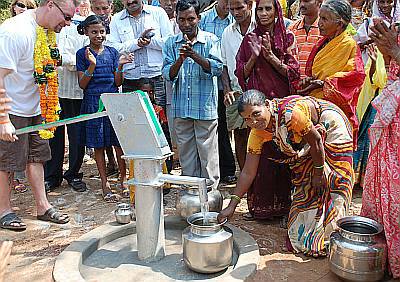
- Viser founded and runs 'Wells for Change' -- an organisation that raises money to build bore wells in rural India, working largely with communities that haven't seen rain in adequate quantities in years.
- Michael returned to the United States, and India became for him another 'experience', another 'story' to share with friends over a drink. A little over a year later, the acquaintance with whom he had stayed invited him to return with a church group from California, that had donated a bore well and was flying down to attend the dedication.
Michael agreed -- and saw, first hand, how the village reacted to the well. "For the first time, I realised that water was a valuable commodity," Viser recalls.
He got talking with a local leader, and learned that his village was in dire need of water and that his community's Dalit status meant they would not have access to the newly-dedicated well. Viser saw this as a sign, the purpose he had been waiting for. But even so, he was aware of what he thought were his own limitations. -
The incident dates back to 2001 -- and Viser has not rested since. Giving up his job, he became a stay-at-home dad for his two children, dedicating all his time to 'Wells for Life'. Since its launch, the group has raised over $1,000,000 and built more than 275 wells, each costing approximately $1,500 in India, and most situated in Andhra Pradesh.
For all the good work he has done, Viser gets his fair share of criticism, mostly about the 'charity model' that 'Wells for Life' has adopted. "The only criticisms I get are from the people in the United States. I say, why are you criticising me? What are you doing? They don't have anything to say in return.
- People involved: include Dr Premdas, who runs an orphanage, and Father Dhana- what do you think they are up to? Conversions. The Evangelical TV in USA routinely shows this-dig wells in India for dalits and for Christ. This is shameful. Each well costs $1500/- and India does not have the money? Especially when MMS gave 150 million dollars to Afghanistan recently as aid. And $ 950 millions in freeHajtrips to muzlims!
India can do all this... it is all humbug missionary activity. As per article, this is mostly in AP- why?SAMUEL reddy's blessing. - 'Wells for Life' is clearly a Christian organisation -- after all, Viser points out, it was his faith that took him to India in the first place. However, he says, he hasn't seen any signs in India that people are questioning his faith -- water is a scarce resource, and no one is too concerned about the religious beliefs of the person providing it.
- And you're going back to help! Why would you want to do that? I tell them I'm doing it because Jesus told me I need to do it. They just smile and that's where it ends."
- Almost the whole of Bengal and the Gangetic plain have been been afflicted by mass poisoning by ARSENIC in drinking water. It came about because of well meaning, overenthusiastic sinking of borewells sponsored by the United Nations.
- He also gets considerable support from the church community, he points out.
- "I just get the money. They do the work." 'They' include Dr Premdas, who runs an orphanage, and Father Dhana, who pulls together the organisational work needed to dig the wells.
- Best to connect Ganges with kauvery river- a proposal that is languishing for 50 years, due to stupid congress leaders' lack of foresight. Such a conccetion of 2 rivers would provide enough water for irrigation and drinking. India must also consult Israel- who are experts in water use; they can help India build catchment areas for catching all the monsoon rains.
- Let this water serve as a reminder that there are people who care for you; that you matter; that there is a God who feels the same way about you. And that's it."
-
Sangh schools score high in Orissa
-
-
- The High School Certificate examinations in Orissa have thrown up a surprise result—hundreds of Saraswati Shishu Vidya Mandirs (SVM) have performed exceptionally well with 44 of the top 102 students coming from the Sangh Parivar-run school network. As many as seven of the top 10 ranks are from SVMs
- From humble beginnings in 1978, the march of these RSS-run schools is a success story that has not been highlighted much. Today, there are over 11,000 Acharyas and Gurumas (teachers) in 739 SVMs across the state who live a no-frills life to teach 1.8 lakh students from kindergarten to Class XII for a pittance.
- parents seem to be happy with the performance of the Saraswati Shishu Vidya Mandirs that dot the towns and villages of Orissa. Pitabas Mehena, father of this year’s topper, Bibek Bishal Mehena, credits his son’s success to the meticulous planning of the teachers and the perfect synergy between students, parents and teachers.
- “Though the teachers get lower salaries than their counterparts in government-run high schools, no one can beat them when it comes to dedication towards their students. For them it is a mission,” said Mehena, a pharmacist in a government hospital.
- Educationists agree that the emotional commitment of the teachers to the students in these schools is what differentiates them from the rest.
- “We don’t get any monetary help from the government. The students pay fees ranging from Rs 50 to 200 a month as per their capability. But we do lay stress on character building and integrity,” said Gobinda Mohanty, Organisational Secretary of the Sikshya Vikas Samiti, the body that oversees the smooth running of these schools.
-
Conversion, reconversion led to Kandhamal riots: Commission
-
- Bhubaneswar
-
"Sources of the violence were deeply rooted in land disputes, conversion and re-conversion and fake certificate issues," Justice S C Mohapatra, heading the one-man panel, said in his interim report on the violence in Kandhamal which claimed 43 lives besides damaging many houses and churches.
He, however, did not elaborate on the conversions and reconversions issue.
-
Why the “heart” always wins… | || Satyameva Jayate ||
-
Why the “heart” always wins… | || Satyameva Jayate ||
-
the best appeals seize people with something emotionally compelling, lay out the alternatives posed by the candidates and “close the argument” with inspiration or outrage.
…
If the other side is trashing you and you say nothing or back down, you cede to your adversaries the neural networks that constitute public opinion. People vote largely with their passions, and if you jam their emotional radar, you prevent them from making emotionally informed decisions.
…
Data from thousands of voters surveyed since the late 1940s suggest that voters tend to ask four questions (in this order) that determine how they vote:
· How do I feel about the candidates’ parties and their principles?
· How does this candidate make me feel?
· How do I feel about this candidate’s personal characteristics, such as integrity, leadership and empathy?
· How do I feel about this candidate’s stands on issues that matter to me?Candidates who focus toward the top of this hierarchy and work their way down generally win. They drink from the wellsprings of partisan sentiments, which account for more than 80 percent of votes. They tell emotionally compelling stories about who they are and what they believe in.
- Please note that all rights (including copyright) rest with the The Washington Post Company.
- Based on my observations in real life, this is not surprising at all. Voting based on rational or logical analysis is vastly over-rated and not backed by facts. Most people do vote based on partisanship, and then rationalize their choice to appear as if the decision was made in a logical manner and theirs was the best choice.
-
Subscribe to:
Posts (Atom)